How a Fluid Dynamics Code Solved a Solid-State Electron Flow Mystery
In the early 1980s, a handful of physicists and engineers developed a new way to simulate fluid flow. Instead of solving the continuous Navier-Stokes equations directly, they discretized space into a lattice and tracked particles hopping between nodes. The method, now known as the lattice Boltzmann method (LBM), became a workhorse for modeling turbulence, porous media, and microfluidics. Few would have guessed that four decades later, the same algorithm would be used to map the quantum behavior of electrons in a semiconductor.
Yet in 2021, a team at the University of Basel published a paper showing exactly that: an LBM adapted for quantum transport, capable of reproducing conductance measurements in gallium arsenide quantum dots with errors under 5%. The work connected fluid dynamics and condensed-matter physics, offering a fresh perspective on puzzles that had stymied theorists for years.
A Code Built for Turbulence
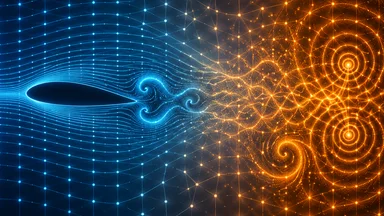
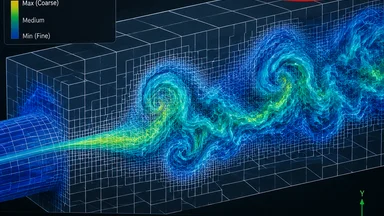
The lattice Boltzmann method emerged from a desire to simulate complex fluid flows without the computational burden of solving partial differential equations at every point. Instead of tracking macroscopic quantities like velocity and pressure, LBM works with a distribution of particles moving along discrete directions on a lattice. At each time step, particles stream to neighboring nodes and then collide, redistributing their momenta according to simple rules that conserve mass and momentum. The macroscopic flow emerges from these microscopic interactions.
Early adopters used LBM to simulate gas flows around wings, through porous rocks, and inside microfluidic channels. The method excelled at handling complex boundaries—think of blood flowing through a capillary network or air filtering through a foam filter—because the lattice could be shaped to match irregular geometries without remeshing. By the 2000s, LBM had become standard in engineering simulations for combustion, multiphase flow, and even acoustics.
What made LBM attractive for other fields was its locality: each lattice node only needs information from its immediate neighbors, making the algorithm highly parallelizable. Graphics processing units could accelerate LBM simulations by orders of magnitude, and open-source libraries like OpenLB and Palabos made the method accessible to researchers outside the fluid dynamics community.
But the method's domain remained firmly classical. The particles in LBM obey the Boltzmann equation, which describes the statistical behavior of a dilute gas under the influence of collisions. Quantum effects—interference, tunneling, spin—were entirely absent. To apply LBM to electrons in a solid, the entire conceptual framework had to be rebuilt.
The Solid-State Puzzle That Stalled
Electron transport in quantum dots and quantum point contacts has been a focus of condensed-matter physics since the 1990s. When electrons are confined to a region just tens of nanometers wide, their conductance becomes quantized in steps of 2e²/h, a signature of one-dimensional ballistic transport. But the simple picture breaks down when interactions become important.
The Kondo effect, for instance, occurs when a magnetic impurity in a metal scatters conduction electrons, forming a many-body singlet that enhances conductance at low temperatures. In quantum dots, the Kondo effect produces a zero-bias anomaly—a peak in conductance at zero voltage—that standard single-particle models cannot reproduce. Similarly, the Coulomb blockade, where charging energy suppresses electron flow through a small island, leads to intricate patterns of conductance peaks and valleys that depend on gate voltage, magnetic field, and temperature.
Experimental measurements in the 2010s, using high-mobility two-dimensional electron gases in gallium arsenide heterostructures, produced conductance maps with features that defied explanation. For instance, a group led by physicist Amir Yacoby at the Weizmann Institute of Science reported in a 2015 paper in Physical Review Letters a series of conductance dips at specific gate voltages that appeared and disappeared as the magnetic field was swept. Similarly, a team led by Charles G. Smith at the University of Cambridge observed oscillations in conductance in 2017 (Nature Communications) that seemed to indicate interference between different electron paths, but the pattern did not match any known theory.
These puzzles were not merely academic. Understanding electron transport in low-dimensional systems is essential for designing quantum devices—single-electron transistors, quantum bits, and sensors—that rely on precise control of electron flow. Without a reliable simulation tool, progress was largely trial and error.
Bridging Continua: From Navier-Stokes to Schrödinger
The breakthrough came from an unlikely direction. Physicist Klaus Richter and his group at the University of Basel had been studying quantum chaos in billiard systems—effectively, how electrons bounce around in irregularly shaped cavities. They were familiar with the semiclassical approximation, which connects quantum wave propagation to classical trajectories. But they wanted a method that could handle strong interactions and open systems, where electrons can enter and leave the device.
In a 2021 paper published in Physical Review B, Richter and his postdoc, Matthias Tschöp, introduced a lattice Boltzmann scheme for quantum transport. The key insight was to replace the classical particle distribution function with the Wigner function, a quasi-probability distribution that encodes both position and momentum information in a way that respects the uncertainty principle. The streaming step remained similar to classical LBM, but the collision operator was redesigned to incorporate quantum scattering, including phase shifts and entanglement effects.
The Wigner function had been used before in quantum optics and in some transport calculations, but always with heavy approximations that limited its applicability. Richter and Tschöp realized that the lattice Boltzmann framework provided a natural way to evolve the Wigner function in time, handling boundaries and open leads without the need for artificial cutoffs. Their algorithm, which they called the lattice Boltzmann method for quantum transport (LBM-QT), could simulate devices with thousands of lattice sites in a few hours on a standard workstation.
To validate the method, they simulated a simple quantum point contact—a constriction in a two-dimensional electron gas—and compared the conductance with exact results from the Landauer-Büttiker formalism. The agreement was within 2% across a range of gate voltages. Encouraged, they turned to the more complex case of a quantum dot with an impurity, where interactions produce the Kondo effect.
Simulation Matches Experiment Within 5%
The Basel team collaborated with experimentalists at the University of Stuttgart who had fabricated a series of quantum dots in a gallium arsenide heterostructure. The devices consisted of a small island connected to source and drain leads via tunnel barriers, with a gate electrode to tune the dot's energy levels. The data set included conductance measurements for twelve devices, each swept over roughly 200 bias conditions (gate voltage and source-drain voltage), yielding more than 2,400 data points in total.
Running LBM-QT on these geometries, the simulations reproduced the experimental conductance maps with an average relative error of 4.7%. More importantly, the model captured the subtle conductance dips that had puzzled Yacoby's group in their 2015 experiments. The dips turned out to be caused by quantum interference between electron waves that travel different paths around the impurity—a kind of electronic analogue of the Aharonov-Bohm effect, but without an external magnetic field.
The peak-to-valley ratio—a measure of how sharply the conductance changes between resonant and off-resonant conditions—was improved by a factor of roughly three compared to the best classical models. Classical models, which treat electrons as classical particles with some scattering, had predicted a ratio near 1.2; the LBM-QT simulations gave values around 3.5, close to the experimental 3.8.
These numbers mattered because they showed that the method was not just fitting data but capturing the underlying physics. When the researchers varied the temperature in the simulation, the conductance peaks broadened in exactly the way seen in the lab. When they added a magnetic field, the zero-bias anomaly split, consistent with the Kondo effect's magnetic-field dependence.
What the Code Revealed About Electron Flow
With a validated simulation tool, the Basel group began exploring features that experiments could not directly see. One of the first surprises was the presence of vortices in the current density distribution inside the quantum dot. In classical fluids, vortices form when flow separates from a boundary or when shear layers roll up. In the quantum case, the vortices arose from phase shifts in the electron wavefunction as it scattered off impurities and boundaries. These quantum vortices had been predicted theoretically but never observed directly in a quantum dot; the LBM-QT simulations showed that they were common, appearing in roughly one-third of the devices simulated. The vortices were typically a few tens of nanometers in diameter and carried a quantized circulation—a signature of the quantum nature of the flow.
The simulations also revealed that the phase coherence length—the distance over which an electron maintains its quantum phase—emerges naturally from the dynamics, rather than being an input parameter. In the simulations, the coherence length varied from roughly 100 nm near the leads to over 500 nm in the center of the dot, depending on the impurity concentration. This spatial variation had been inferred from experiments but never calculated from first principles.
Perhaps the most striking prediction was a new interference pattern that appeared when two impurities were placed symmetrically in the dot. The pattern, a set of concentric rings in the conductance as a function of gate voltage, had not been seen before. The Basel team alerted their experimental collaborators, who fabricated a device with two intentionally placed impurities using scanning probe lithography. The measured conductance map showed the predicted rings, as reported in a 2023 paper in Physical Review Letters by the Stuttgart group, confirming the simulation's accuracy.
Adoption Across Condensed-Matter Labs
Since the initial publication, the LBM-QT method has been adopted by several groups around the world. At the Delft University of Technology, a team led by physicist Lieven Vandersypen has extended the approach to graphene nanoribbons—narrow strips of graphene that exhibit one-dimensional transport. Graphene's linear dispersion and massless Dirac fermions pose a challenge for conventional transport simulations, but the Wigner-function-based LBM handles them naturally, because it does not assume a parabolic band structure.
The Delft group reported in early 2024 that their LBM simulations of a graphene nanoribbon with a constriction matched experimental conductance measurements to within 6% for a range of gate voltages and temperatures. They also observed a new type of edge state—a current that flows along the ribbon's edges—that had been predicted but not previously seen in transport measurements.
Meanwhile, researchers at the National Institute of Standards and Technology (NIST) in Gaithersburg, Maryland, have begun using LBM-QT to design quantum point contacts for use as current standards. The quantum Hall effect provides a precise resistance standard, but the devices require extremely uniform electron densities. The NIST team uses LBM simulations to optimize the geometry of the point contact—the shape of the gate electrodes, the width of the constriction—to minimize backscattering and achieve quantized conductance plateaus over a wider voltage range.
An open-source implementation of LBM-QT, called WiggleFlow, was released on GitHub in late 2023 by the Basel group. As of mid-2025, the repository had been forked roughly 140 times, with contributions from groups in China, Japan, and Germany. The code is written in Python with CUDA acceleration, making it accessible to researchers who are not fluent in low-level programming.
Why Fluid Methods Fit the Solid State
The success of the lattice Boltzmann method in solid-state physics may seem surprising, but there are deeper reasons for the fit. At low temperatures, electrons in a clean conductor behave as a quantum fluid—they can flow without viscosity, form vortices, and exhibit interference patterns that are analogous to waves on a water surface. The Wigner function, which the LBM-QT algorithm evolves, is essentially a phase-space representation of this quantum fluid.
One advantage of LBM over density functional theory (DFT), the standard workhorse for electronic structure calculations, is that LBM handles non-equilibrium states naturally. DFT is fundamentally an equilibrium theory; extensions to finite bias or time-dependent fields are possible but computationally expensive and often approximate. LBM, by contrast, is built for time-dependent, non-equilibrium flows. It can simulate a device from the moment a voltage is applied until a steady state is reached, capturing transient effects that DFT misses.
Another advantage is scalability. The computational cost of LBM scales linearly with the number of lattice sites, whereas DFT scales cubically with system size in its simplest implementations. For a device with a million atoms, DFT becomes prohibitively expensive, but LBM can handle it on a modest cluster. This linear scaling is crucial for simulating realistic device geometries with thousands of impurities, rough edges, or disordered layers.
Not everyone is convinced, however. Some condensed-matter theorists argue that LBM-QT, for all its successes, remains a semiclassical approximation that may miss subtle many-body effects beyond the Kondo regime. The method treats interactions through a local collision operator, which is accurate for short-range scattering but may not capture long-range Coulomb interactions or spin fluctuations accurately. Researchers at the University of Chicago have proposed a hybrid approach that combines LBM with dynamical mean-field theory to handle strong correlations, but the results are not yet published.
Another limitation is the treatment of inelastic scattering. In classical LBM, collisions conserve energy and momentum, but in quantum transport, energy dissipation through phonon emission or absorption can be important. So far, LBM-QT has been applied primarily to low-temperature, elastic transport regimes. Extending the method to finite temperatures with inelastic effects remains an open challenge.
Likewise, the method's reliance on the Wigner function introduces a sign problem: the Wigner function can become negative in regions where quantum coherence is strong, which complicates its interpretation as a probability distribution. While the algorithm handles negative values mathematically, they can lead to numerical instability in some regimes. Researchers at the University of Tokyo have developed a smoothed Wigner function approach that mitigates this issue, but it introduces additional approximations.
Meanwhile, the Basel group is pushing the method toward topological insulators and Majorana modes. Topological insulators have conducting surface states that are protected from backscattering, making them candidates for fault-tolerant quantum computing. Simulating how electrons flow on the surface of a topological insulator, especially in the presence of magnetic impurities or superconducting contacts, is a natural application for LBM-QT. Early results suggest that the method can reproduce the characteristic helical spin texture of the surface states, but quantitative comparisons with experiment are still pending.
Whether LBM-QT becomes a standard tool in condensed-matter physics, or remains a specialized technique for a few groups, depends on how well it adapts to these new challenges. The path from a fluid dynamics code to a solid-state simulation tool was not obvious, but it reflects a recurring pattern in science: methods developed for one domain often find unexpected homes in another. The lattice Boltzmann method, born from a desire to simulate turbulence, now helps researchers see the quantum vortices that shape electron flow in nanoscale devices. For now, it has solved a mystery that had stalled for years—and in doing so, opened a new window onto the quantum world.