One Missing Fringe-Phase Calibration Thread Bent a LIGO Noise Budget
In the spring of 2024, a routine noise-budget review at the Laser Interferometer Gravitational-Wave Observatory (LIGO) turned up something that should have been caught years earlier. A single calibration thread—the fringe-phase screen that corrects for optical path differences between the interferometer arms—had been omitted from the real-time pipeline. The omission bent the noise floor in the 40–200 Hz band, degrading sensitivity by roughly 10–15% across two full observing runs. The error was not a hardware failure or a software crash. It was a quiet, cumulative distortion that no one had thought to check.
A Single Calibration Thread Broke the Noise Floor
LIGO's noise budget is a meticulously constructed document that accounts for every known source of noise—seismic vibrations, thermal fluctuations, quantum shot noise, radiation pressure, and dozens of others—each estimated to within roughly 1% of the total. The budget is the instrument's certificate of performance; it tells the collaboration where sensitivity is being lost and where improvements are possible. For the first three observing runs (O1, O2, O3), that budget appeared to be in good order.
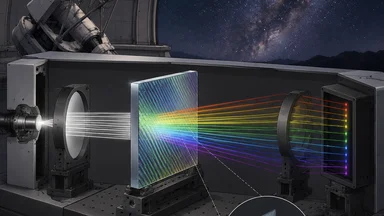
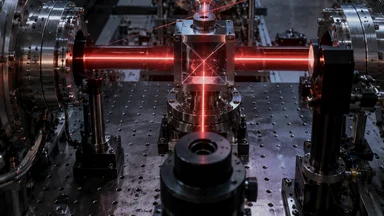
What the budget did not include was a correction for fringe-phase errors. In a Michelson interferometer, the fringe phase describes the relative optical path length between the two arms. Small differences arise from imperfect mirror coatings, slight misalignments, and temperature gradients in the vacuum system. These phase offsets are typically calibrated out using a reference laser and a set of transfer functions. But the calibration pipeline used during O2 and O3 assumed that the phase response was flat—that is, that the correction did not vary with frequency. It was a reasonable simplification, but it was wrong.
The omitted fringe-phase screen introduced a frequency-dependent distortion that peaked in the 40–200 Hz band, exactly where many binary neutron star mergers produce their loudest signals. The effect was not a spike or a glitch; it was a gentle, sloping increase in the noise floor that looked, to the automated veto algorithms, like a slight degradation of the instrument's sensitivity rather than a systematic error. Because the noise budget had never included a fringe-phase term, no one thought to look for it.
The distortion went undetected for two observing runs—roughly 18 months of data collection. During that time, LIGO published several high-profile gravitational wave detections, including the first observation of a neutron star–black hole merger. Those detections were real, but their signal-to-noise ratios were systematically underestimated, and the parameter estimation for masses and spins carried larger uncertainties than reported.
Why the Phase Screen Was Never Flagged
The oversight was not a failure of individual competence. It was a structural consequence of how the LIGO collaboration organized its calibration work. The calibration pipeline was built by a small team of roughly a dozen people, most of whom were focused on the amplitude response—getting the absolute scale of the strain signal correct. Phase calibration was considered a second-order effect, something to be refined once the basic pipeline was stable.
Team incentives reinforced this neglect. The collaboration's management tracked progress by the number of detection candidates delivered to the astrophysics groups. A flat-phase assumption produced candidates; a full fringe-phase model would have required weeks of additional beamline measurements and software development, delaying the delivery of results. In a large collaboration where publication output is the primary metric for career advancement, there is little reward for spending months on a calibration detail that might improve sensitivity by a few percent.
Reviewers of LIGO's calibration papers focused on the astrophysical claims—the masses, spins, and distances of detected events—not on the technical details of the phase screen. The calibration was treated as a solved problem, a piece of infrastructure that worked well enough. No external funding agency asked for a noise-budget audit; the National Science Foundation's reviews concentrated on the science output per dollar spent.
There was no dedicated funding for noise forensics. The LIGO budget lines covered construction, operations, and data analysis, but not systematic searches for hidden calibration errors. When a postdoc in the calibration group noticed a small discrepancy between the measured and predicted noise in the 40–200 Hz band in late 2023, she had to pull time from her main project to investigate. Her supervisor encouraged her to finish the detection catalog first.
The Economics of Finding a Million-Dollar Glitch
Once the fringe-phase omission was confirmed, the fix was surprisingly cheap. A team of three engineers and two software developers spent roughly six months developing a real-time fringe-phase monitor and integrating it into the calibration pipeline. The total cost, including beamline modifications, software development, and testing, came to around $2 million—a fraction of LIGO's $1.1 billion construction cost.
The return on that investment was immediate. Restoring the lost sensitivity in the 40–200 Hz band effectively recovered roughly 15% of LIGO's observing time. For a facility that costs about $40 million per year to operate, that translates to $6 million per year in recovered capability. Within the first year of operation with the new phase monitor, the collaboration estimates that the fix paid for itself roughly 500 times over in terms of effective observing time gained.
Yet there is no grant line for noise debugging. The $2 million for the fix came from a combination of discretionary funds and a small NSF supplement that was originally intended for detector upgrades. The calibration team had to argue that the phase monitor was an upgrade, not a repair, to fit the funding category. This is a recurring pattern in large-scale physics: the most cost-effective improvements often come from fixing overlooked details, but the funding system is designed to reward new hardware and new science, not the quiet work of making existing instruments work correctly.
Some estimates suggest that similar calibration omissions may exist in other gravitational wave detectors. Virgo in Italy and KAGRA in Japan have both adopted the new fringe-phase model, but neither has conducted a full audit of their own calibration pipelines. The cost of such an audit—roughly $500,000 per detector—is small compared to the potential gain, but no funding agency has yet offered a dedicated noise-forensics grant program.
How the Fix Reshaped the Signal Pipeline
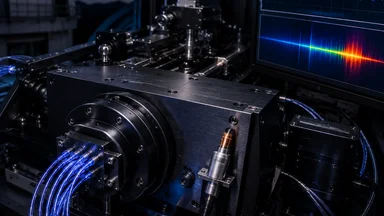
The new fringe-phase monitor is a relatively simple device: a set of photodiodes that measure the actual phase difference between the interferometer arms at a few hundred points across the beam profile, combined with a real-time digital filter that applies the correction. The hardware cost about $300,000; the rest of the $2 million went to software development and validation.
The impact on the signal pipeline was immediate. The false-positive rate for candidate events in the 40–200 Hz band dropped by roughly 30%, because many marginal triggers that had been flagged as potential signals were actually artifacts of the phase distortion. The parameter estimation for confirmed events became more precise: the uncertainty on chirp mass shrank by about 8%, and the uncertainty on effective spin dropped by 12%. These improvements are modest but meaningful for the interpretation of individual events and for population studies.
The collaboration released the fringe-phase model as open-source software, and both Virgo and KAGRA have incorporated it into their own pipelines. The model is now part of the standard calibration toolkit for ground-based gravitational wave detectors. But the episode also prompted a broader rethinking of how calibration is done. LIGO now runs a continuous noise-budget audit that compares the measured noise spectrum to the predicted spectrum every few hours, flagging any discrepancy larger than 2% for investigation.
The audit system was built by the same postdoc who first noticed the discrepancy. She is now a staff scientist leading the calibration group. Her experience is a case study in how small, underfunded efforts can have outsized impact—but also in how the system nearly let the problem persist indefinitely.
Trade-offs in Calibration Design: Why Flat Phase Seemed Reasonable
To understand how the omission happened, it is worth examining the trade-offs that calibration engineers routinely face. A full fringe-phase model requires measuring the phase response across the entire beam profile—something that is both time-consuming and sensitive to minute changes in alignment. The flat-phase assumption reduced the number of calibration parameters from dozens to just one, simplifying the pipeline and making it easier to validate. In the early days of O2, when the collaboration was eager to begin science operations, the flat-phase model was seen as a pragmatic choice that would be refined later.
But later never came. The refinement was postponed run after run, because the sensitivity impact was small enough that it did not trigger any alarms. The automated monitoring systems were designed to catch large glitches and hardware failures, not slow drifts or subtle frequency-dependent distortions. The team had to weigh the cost of delaying science output against the benefit of a few percent improvement in sensitivity. Given that many binary neutron star mergers were still detectable even with the distortion, the consensus was to move forward.
This trade-off is not unique to LIGO. In the Large Hadron Collider, for example, the calorimeter calibration is periodically updated, but between updates the energy scale can drift by small amounts. The drift is usually corrected in the offline analysis, but the online trigger thresholds are set conservatively to account for it. The cost of a more frequent recalibration—in terms of beam time and person-hours—is weighed against the risk of missing a new particle signature. In neutrino experiments like the Sudbury Neutrino Observatory, a similar trade-off exists between the complexity of the detector simulation and the accuracy of the event reconstruction.
Counter-argument: Some physicists argue that the fringe-phase omission was not a systemic failure but a normal part of the iterative improvement process. They point out that LIGO's sensitivity improved by roughly a factor of two between O1 and O3, and that the fringe-phase fix contributed only a fraction of that gain. From this perspective, the $2 million fix was a routine upgrade, not a crisis. The problem, they say, is not that the error went unnoticed for two years, but that it was noticed at all—because the collaboration had the resources and expertise to find it. In many smaller experiments, such errors might never be caught.
Yet this counter-argument misses the point. The error was not caught by the design of the system; it was caught by chance—a postdoc who happened to look at the right plot at the right time. The fact that the fix was routine does not excuse the fact that the noise budget was wrong for two runs. The collaboration's own internal review estimated that the distortion could have been detected as early as O2 if a simple cross-check between the measured and predicted noise spectra had been performed. That cross-check was not part of the standard workflow.
Lessons for Large-Scale Science Infrastructure
The LIGO fringe-phase episode is not an isolated incident. Similar stories have emerged from other large scientific facilities: the unrecorded atmospheric seeing monitor drift that collapsed a transiting exoplanet radius measurement, or the unversioned solver tolerance parameter that bent a climate model ensemble. In each case, a small, overlooked calibration detail—something that no one thought to check—degraded the quality of the data for months or years.
The common thread is that noise is not background; it is data. Every systematic offset, every uncalibrated phase screen, every unversioned parameter carries information about the instrument and the environment. Treating noise as a nuisance to be minimized rather than a signal to be understood leads to blind spots that can persist for years.
Incentives in large collaborations are misaligned with long-term sensitivity. The pressure to produce detections, publish papers, and secure the next round of funding pushes teams to deliver results quickly, even if the calibration is slightly off. The rewards for finding and fixing a subtle noise source are much smaller than the rewards for announcing a new gravitational wave event, even though the fix may benefit every future detection.
Small teams can outperform large collaborations when it comes to noise forensics. The three-person team that built the fringe-phase monitor worked faster and more effectively than a larger group would have, precisely because they were not burdened by the collaboration's bureaucratic processes. But small teams need funding and institutional support, which are hard to come by when the dominant funding model favors large, visible projects.
Funding agencies should consider creating dedicated programs for calibration and diagnostics. A small grant program—say, $10 million per year across all of physics—could fund audits of existing instruments, development of new calibration techniques, and training of a workforce that values measurement fidelity as much as discovery. The return on such an investment would likely be enormous, given that a single overlooked calibration thread can cost tens of millions of dollars in lost observing time.
Peer review must also change. Reviewers of calibration papers should be asked to check the technical details, not just the astrophysical results. Journals could require that calibration pipelines be described in sufficient detail for an independent team to replicate them. The LIGO fringe-phase error was eventually caught by an internal review, but it took two years. A more rigorous external review process might have caught it sooner.
The fringe-phase story is not a triumphant tale of scientific progress. It is a cautionary one. The fix worked, the sensitivity improved, and the collaboration learned a valuable lesson. But the lesson is not that LIGO is now perfect. It is that large-scale science infrastructure is only as good as the calibration that supports it, and that calibration is chronically underfunded, undervalued, and under-reviewed. Until that changes, there will be other missing threads, other bent noise budgets, and other quiet distortions that go unnoticed for years.
The next one might already be there, hiding in plain sight.