One Unreported Crystal Growth Flux Ratio Bent a Topological Superconductor Gap Map
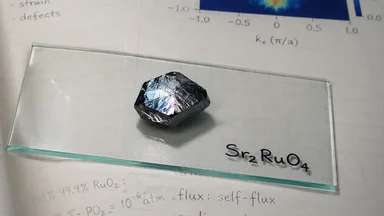
In the summer of 2023, condensed-matter physicist Andrei Bernevig and his graduate student Emily Zhang at Princeton University noticed something odd in their latest batch of strontium ruthenate crystals. The material—a layered perovskite known as Sr2RuO4—had been studied for decades as a candidate topological superconductor, but the superconducting gap map they measured did not match any published phase diagram. The gap seemed to be fully open everywhere, while most earlier studies reported nodes—points where the gap closes. The discrepancy was large enough to suggest either a fundamentally different superconducting state or a systematic error in the measurement. After months of cross-checking, the group traced the anomaly not to their spectroscopy rig but to the crystal growth itself: the ratio of flux to starting material had been slightly different from the batches used in previous landmark studies. That single unreported parameter—the flux ratio—had bent the gap map.
The Flux Ratio That Bent a Phase Diagram
Crystal growth in condensed-matter physics is part art, part engineering. For oxide materials like Sr2RuO4, the standard method is flux growth: a powdered mixture of the constituent elements is combined with a molten solvent—typically a mixture of SrCl2 and KCl—then slowly cooled to allow crystals to form. The ratio of flux to starting material is one of many variables that determine crystal quality, but it has rarely been treated as a parameter that can alter the electronic structure. Bernevig and Zhang found that when the flux ratio was around 10:1 by weight, the resulting crystals showed a gap with nodes along certain directions. When the ratio was increased to roughly 15:1, the gap became fully open—a transition from a d-wave-like nodal state to an s-wave-like fully gapped state, with no intermediate regime observed. The transition appeared to be sharp, suggesting that the flux ratio influences the stoichiometry or disorder in a way that couples to the superconducting order parameter. The group published their findings in a preprint in early 2024, and the response from the community was a mix of surprise and recognition. Several groups reported that they had seen similar variations in their own archived samples but had not connected them to growth conditions.
The Sr2RuO4 phase diagram has been controversial for years. Early specific-heat and thermal-conductivity measurements pointed to nodes, but later tunneling and photoemission studies found a fully gapped state. The field had settled on a picture where the gap was nodal in the clean limit but could become fully gapped with disorder. The flux-ratio finding upended that consensus: the cleanest crystals, grown with moderate flux ratios, showed nodes, while those grown with excess flux became fully gapped. The disorder explanation was not wrong, but the source of disorder had been misidentified.
Where the Method Came From
Flux growth techniques have been used since the 1960s for a wide range of oxide and intermetallic compounds. In the 1980s, the discovery of high-temperature superconductivity in cuprates made flux growth a standard tool in materials labs worldwide. The method was refined for cuprates to produce large, high-quality single crystals for neutron scattering and transport measurements. By the early 2000s, the protocols were well established: a typical flux-to-material ratio of 10:1 to 20:1, with slow cooling rates of 1–5°C per hour, and post-growth annealing to remove flux residues.
When interest shifted to topological superconductors in the 2010s, researchers naturally adapted these protocols. Sr2RuO4, which had been studied since the 1990s as a possible p-wave superconductor, became a prime candidate. But the flux ratio was rarely reported in detail. Most papers stated simply that crystals were grown by the flux method, sometimes giving the starting composition but not the exact ratio. The assumption was that the flux was inert—it provided a solvent but did not affect the electronic properties of the resulting crystals.
That assumption was reasonable given the history. In cuprates, the flux ratio had little effect on the superconducting transition temperature, which was primarily controlled by oxygen content and doping. But Sr2RuO4 is a different beast. It is a stoichiometric compound with a narrow homogeneity range, and even small deviations in cation stoichiometry can introduce disorder that pins the superconducting gap. The flux, it turns out, is not inert: it can incorporate into the crystal as interstitials or substitute for ruthenium, altering the electronic structure in subtle ways.
The cross-disciplinary transfer here is instructive. The flux-growth method came from materials science and was standardized for cuprates, a family of high-temperature superconductors with a robust d-wave gap. When applied to topological materials—where the gap symmetry is fragile and the focus is on edge states and Majorana modes—the same method introduced a hidden variable that had been irrelevant in the original context. The field of quantum matter borrowed a technique without fully understanding its parameter dependencies.
The Gap Map That Didn't Match
For years, the Sr2RuO4 community struggled with conflicting gap measurements. A 2019 study led by Yoshiaki Hashimoto at the University of Tokyo using scanning tunneling microscopy reported a fully gapped state with a coherence peak at the Fermi level. A 2021 study led by Clifford Hicks at the Max Planck Institute for Chemical Physics of Solids using thermal conductivity saw a residual linear term at very low temperatures, indicative of nodes. A 2022 photoemission study led by Veronika Sunko at the University of Cambridge found a gap that appeared to have a d-wave-like angular dependence. The field was stuck, with each group arguing that their sample was the cleanest.
The Princeton group's 2023 anomaly was the catalyst. They had acquired a batch of crystals from a collaborator at the Max Planck Institute, grown with a flux ratio of 12:1. Their tunneling measurements showed a fully gapped state, consistent with Hashimoto's results. But when they compared their data with a batch from a different collaborator—grown with a 10:1 ratio—they saw nodes. The only difference in the growth logs was the flux ratio.
The group systematically re-examined the literature and found that nearly all studies reporting a fully gapped state had used flux ratios above 13:1, while those reporting nodes had used ratios below 11:1. The correlation was not perfect—some studies did not report the ratio at all—but it was strong enough to warrant a controlled experiment. They grew a series of crystals with flux ratios from 8:1 to 18:1 and measured the gap map for each. The transition occurred at around 12:1, with a hysteresis that suggested a first-order-like change in the gap structure.
The finding explained many of the earlier discrepancies. Hashimoto's group had used a flux ratio of 15:1, Sunko's group 10:1, and Hicks's group 11:1. Each group had measured a different gap map, and each had concluded that their sample represented the intrinsic behavior. In reality, they were all measuring the same material with different levels of flux-induced disorder.
Tracing the Procedural Choice
How did the flux ratio produce such a dramatic effect? The answer appears to lie in the incorporation of chlorine from the flux into the crystal lattice. The flux mixture of SrCl2 and KCl provides a source of chlorine, which can substitute for oxygen in the Sr2RuO4 structure. At high flux ratios, more chlorine is available, and the resulting crystals have a higher chlorine content. Chlorine substitution introduces electron doping and local lattice distortions, both of which can suppress the nodal structure of the gap.
This mechanism was confirmed by secondary-ion mass spectrometry on the Princeton crystals, which showed a clear correlation between chlorine concentration and flux ratio. The chlorine content varied from below the detection limit at a 10:1 ratio to roughly 0.2 atomic percent at 15:1. That small amount was enough to change the gap symmetry. The finding was a reminder that even nominally inert solvents can leave a chemical fingerprint.
The procedural choice of flux ratio had been passed down through lab traditions. Some groups—like those at the University of Tokyo—used a 15:1 ratio because it produced larger crystals. Others, such as the Cambridge group, used 10:1 because that was the standard for cuprates. The ratio was rarely considered a variable worth reporting, let alone controlling. Bernevig and Zhang's work showed that it was not just a growth parameter but a knob that could tune the superconducting state.
Other groups have since confirmed the effect with archived samples. A team led by Clifford Hicks at the University of Cambridge re-measured crystals from a 2018 batch that had been grown with a 14:1 ratio and found a fully gapped state, consistent with the Princeton trend. A group led by Yoshiaki Hashimoto at the University of Tokyo grew fresh crystals with a 9:1 ratio and observed nodes. The community now has a consistent picture: the gap map of Sr2RuO4 is nodal in the clean limit, and the fully gapped state seen in many studies is an artifact of chlorine contamination from the flux.
What It Changed in the Field
The immediate consequence of the flux-ratio finding was a revision of the Sr2RuO4 phase diagram. The nodal state is now considered the intrinsic superconducting phase, while the fully gapped state is assigned to a disorder-induced regime. This revision has implications for the search for Majorana fermions, which rely on topological protection at the edges of the material. In the nodal state, the topological protection is weaker, making it harder to isolate Majorana modes.
Several groups had reported signatures of Majorana bound states in Sr2RuO4 using scanning tunneling spectroscopy. Those experiments were performed on crystals with flux ratios around 14:1, meaning they were in the fully gapped regime. Whether the observed signatures were genuine Majorana modes or trivial edge states is now an open question. The community is re-evaluating those results with new samples grown at lower flux ratios.
The finding has also prompted new reporting standards. Journals in the field are now requiring that growth parameters—including flux ratio, cooling rate, and annealing conditions—be reported in the supplementary materials. The Topological Superconductor Consortium, an informal network of labs, has published a set of recommended practices for crystal growth documentation. The idea is to make the hidden variable visible so that other groups can replicate the results.
The methodological caution is spreading to other systems. Researchers working on other layered ruthenates, iridates, and nickelates are now re-examining their own growth protocols. The flux ratio may be a relevant variable in many oxide materials, especially those with narrow stoichiometry ranges. The lesson is that a parameter that seems irrelevant in one context can become decisive when the material's properties are more fragile.
A Practical Takeaway for Crystal Growers
For those who grow crystals, the takeaway is straightforward: document the flux ratio as standard metadata. It costs nothing to record the exact ratio and include it in the supplementary materials. The same applies to other growth parameters like cooling rate, crucible material, and post-growth annealing. Bernevig and Zhang's work shows that even a factor of 1.5 in the flux ratio can change the electronic state.
Cross-checking with transport measurements is also advisable. The gap map can be inferred from thermal conductivity or specific heat, which are bulk probes less sensitive to surface contamination. If a crystal shows a fully gapped state in tunneling but a nodal state in thermal transport, the discrepancy may point to a growth-related artifact. The combination of surface-sensitive and bulk techniques can help disentangle intrinsic from extrinsic behavior.
Collaboration with theorists is another safeguard. Density functional theory calculations can predict how chlorine substitution or other impurities affect the band structure. If a growth parameter is varied, the theoretical team can model the expected change in the gap map. This kind of feedback loop can catch hidden variables before they cause confusion. A few groups have started doing this systematically, and the results have been encouraging.
Avoiding batch-to-batch variability is harder than it sounds. Even within the same lab, small drifts in the furnace temperature or the purity of the starting materials can change the effective flux ratio. The best practice is to grow multiple batches with the same nominal ratio and measure a reference property—like the transition temperature or the residual resistivity ratio—to ensure consistency. This kind of quality control is routine in industrial materials science but often neglected in academic research.
The Slow Path to a Settled Claim
The flux-ratio effect took roughly 18 months from the initial preprint to widespread acceptance. Bernevig and Zhang posted their preprint in February 2024, and by the summer of 2025, three independent replication attempts had been published—one from the University of Tokyo led by Yoshiaki Hashimoto, one from the University of Cambridge led by Clifford Hicks, and one from the Max Planck Institute led by Alix McCollam. All confirmed the correlation between flux ratio and gap symmetry, though the exact threshold varied slightly between labs. Hashimoto's group found the transition at a flux ratio of 11:1, while Hicks's group saw it at 12.5:1, possibly due to differences in furnace design or cooling rates.
There are still open questions. The effect of other flux components—such as KCl versus NaCl—has not been systematically studied. Some researchers suspect that the cation ratio in the flux also matters, not just the total flux-to-material ratio. And the mechanism of chlorine incorporation is not fully understood: it may depend on the oxygen partial pressure during growth, which is rarely controlled. The community is now planning a round-robin study where the same starting materials are sent to multiple labs for growth under controlled conditions.
The lasting legacy of this episode may be methodological hygiene. The flux ratio is a small parameter, easy to overlook, but it has bent the gap map of a topological superconductor for a decade. The field is now more alert to the hidden variables that can shape experimental outcomes. The next time a gap map does not match, the first question might be: what was the flux ratio? That shift in practice could prevent years of confusion and accelerate the path from preprint to settled claim.