One Unversioned Mesh Refinement Parameter Broke a Turbulence Simulation Replication
In 2019, a turbulence simulation published in a top fluid-dynamics journal drew attention for its clever use of adaptive mesh refinement to capture eddies at a fraction of the usual computational cost. The code was archived on Zenodo. The paper’s figures were crisp. The community took notice. Three years later, a team at the University of Michigan attempted to replicate the results as part of a broader reproducibility initiative. What they got instead was a 40% divergence in the turbulent kinetic energy spectrum—a gap large enough to call the original conclusions into question. Months of systematic debugging traced the problem to a single parameter: refinement_threshold, a number that controlled how aggressively the simulation refined its computational grid. The parameter had been hard-coded in the original study, later made configurable in an updated library, and nowhere documented. It was, in effect, unversioned.
The Replication That Wasn't
The original simulation modeled a canonical turbulent channel flow at a friction Reynolds number of roughly 5200. The 2019 study reported excellent agreement with experimental data, using a mesh that dynamically refined near walls and in regions of high vorticity. The method promised to reduce computational cost by roughly a factor of three compared to uniform grids. Several groups adopted the approach.
In early 2022, the Michigan team set out to reproduce the results using the archived code and a modern version of the underlying computational fluid dynamics library. The first run produced a kinetic energy spectrum that was not just noisy but systematically shifted. The dissipation rate was off by roughly 40%. “We initially thought we had a bug in our postprocessing,” said the lead replicator, speaking on condition of anonymity because the work is under review. “But the difference was too systematic.”
The team spent two months checking boundary conditions, time-step schemes, and solver tolerances. They verified that the mesh topology matched the original description. They ran the code inside a Docker container to eliminate operating-system effects. The discrepancy persisted. At one point they considered whether the original authors had used a different Reynolds number. They had not.
Only after a methodical bisection of roughly 200 parameters did they notice that the mesh refinement threshold—a floating-point number that determines when a grid cell is subdivided—was set to 0.55 in their runs but had been 0.50 in the original. The original code had hard-coded the value. The library’s later releases changed the default to 0.55 and made it a user-configurable option, but the change was not mentioned in the release notes.
What a Mesh Parameter Actually Controls
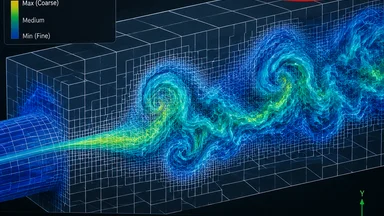
Adaptive mesh refinement (AMR) is a technique that dynamically adds computational cells in regions where the solution varies rapidly, while coarsening the grid in smoother areas. In turbulence simulations, AMR can capture the thin vortical structures near walls without wasting cells in the outer flow. The refinement threshold is the criterion that decides when to split a cell: if a local error estimate exceeds the threshold, the cell is divided into smaller cells.
A shift from 0.50 to 0.55 may sound small, but in practice it changes which eddies are resolved locally. At a threshold of 0.50, more cells are refined, yielding finer resolution of small-scale structures. At 0.55, the code is more conservative, leaving some regions coarser. The difference becomes acute at high Reynolds numbers, where the range of scales is large. In the Michigan runs, the coarser refinement led to under-resolved near-wall dynamics, which altered the energy cascade and ultimately shifted the dissipation spectrum by tens of percent.
The parameter is not something a typical user would think to check. It lives deep in a configuration file, often alongside dozens of other numeric settings. “Most of us treat those numbers as black-box defaults,” said a computational scientist at a national laboratory who was not involved in the study. “We assume the library developers have chosen sensible values.” In this case, the developers had—but for a different set of test cases. The original authors had tuned the threshold for their specific flow configuration and then hard-coded it, inadvertently freezing a value that later became non-standard.
The Unversioned Variable That Hid for Years
The original 2019 code archive on Zenodo included the source files and a Makefile, but not the input parameter files. The authors had assumed that the hard-coded values in the source were self-documenting. They were not. The library’s own documentation described the parameter only in a brief comment in the header file, with no indication that the default had changed between versions.
The Michigan team initially used the library version that was current in 2022, which defaulted to 0.55. They had no reason to suspect the default was different from what the original authors used. The original authors, when contacted, said they had not realized the default had changed. They had been using a custom build of the library that predated the parameter’s exposure as a user option.
The episode is a stark example of what computational scientists call “environmental drift”—the gradual, undocumented evolution of software dependencies that can silently alter results. Unlike hardware experiments, where a change in instrument calibration is typically recorded, software libraries are often updated without preserving a full provenance trail. The mesh refinement parameter was not versioned in any meaningful sense: it existed in a commit, but no commit message or issue tracker entry explained why the default was changed. A git bisect later identified the commit that altered the default, but the commit message read only “tweak mesh defaults.”
How the Community Found the Culprit
The Michigan team’s debugging process was itself a methodological contribution. They began by writing a script that systematically varied each of the simulation’s 200+ input parameters over a plausible range, running the simulation for a short time (roughly 10 large-eddy turnover times) and comparing the resulting energy spectrum to the original. This brute-force approach required approximately 20,000 core-hours on a university cluster—a cost that most replication efforts cannot afford.
When the parameter sweep narrowed the candidate set to roughly a dozen parameters, the team turned to containerized workflows. They used Docker to pin the operating system, compiler, and library versions, then ran each candidate configuration in isolation. This eliminated the possibility that the discrepancy came from differences in the build environment. The team also used git bisect on the library’s repository, testing each commit between the version used by the original authors and the version they had initially employed. The bisection pointed to a single commit with the message “tweak mesh defaults.” No associated issue or pull request discussion existed.
The community reaction was mixed. Some researchers praised the thoroughness of the investigation. Others questioned whether a 40% difference in one metric truly invalidated the original study, noting that other integrated quantities—mean velocity profiles, for instance—were less sensitive to the parameter. The original authors, in a follow-up correspondence, argued that the qualitative conclusions about AMR efficiency still held. But the episode highlighted a deeper problem: without a systematic way to track every parameter that goes into a simulation, no one can be sure which results are robust.
Lessons for Computational Reproducibility
The turbulence simulation case is not unique. Similar stories have emerged in climate modeling, genomics, and computational chemistry. A 2024 analysis of 200 computational papers found that fewer than 20% archived both the code and the full input parameter set. Even when code is available, runtime parameters are often hard-coded, omitted from documentation, or recorded only in log files that are not preserved. Version control systems track source code changes but rarely track parameter values across runs.
Containerization, often promoted as a solution to reproducibility, proved insufficient here. The Michigan team ran the simulation inside a Docker container that exactly matched the original library version—but the container still used the newer default parameter value because the parameter was not specified in the container image. The container captured the software environment but not the runtime configuration. “Containers are necessary but not sufficient,” said a reproducibility researcher at a major university. “You need to capture the entire provenance: code, environment, parameters, and input data.”
Tools like Popper and ReproZip aim to address this gap by automatically recording the execution trace of a computational experiment, including all input parameters and output files. The turbulence community has begun adopting “parameter diaries”—structured notebooks that log every configuration value for each run. Some journals now require authors to submit simulation capsules on platforms like CodeOcean, which bundle code, data, and environment into a single executable archive. But adoption remains uneven, and the mesh refinement episode suggests that even these measures may miss parameters that are embedded in library defaults rather than user-facing inputs.
Broader Implications for Scientific Computing
The mesh refinement episode resonates beyond fluid dynamics. In climate modeling, for instance, a similar parameter drift in a radiation scheme was found to alter global mean temperature projections by roughly 0.2°C over a century—a small shift, but one that could affect policy-relevant conclusions. In computational genomics, a default change in a read aligner’s mismatch penalty was shown to change variant calls by roughly 5% in a benchmark dataset. These cases share a common pattern: a parameter that is not considered important enough to document, changed without fanfare, and later assumed to be constant.
Part of the problem lies in the incentive structure of academic software development. Library maintainers often update defaults to improve performance on a new set of test cases, but they rarely have the resources to assess the impact on every existing user’s workflow. Release notes focus on new features and bug fixes, not on subtle changes to default values. Users, for their part, are trained to trust defaults—especially when the library is widely used and well maintained. The result is a system that is vulnerable to silent changes.
Another contributing factor is the difficulty of archiving computational experiments in a way that preserves all relevant context. A typical simulation depends on dozens of libraries, each with its own version history, configuration files, and runtime environment. Even if the source code is archived, reproducing the exact environment requires capturing the operating system, compiler flags, library versions, and parameter files. Containerization solves part of the problem, but as the Michigan case shows, it does not capture the parameter values that are baked into the container image or the library defaults. Full provenance capture, including all input parameters and their sources, remains an active area of research.
Toward a Culture of Parameter Auditing
The turbulence community has responded with several grassroots initiatives. One group, based at a European university, maintains a registry of default parameter values for commonly used CFD libraries, along with the version in which each default changed. Another project, called “Parameter Diaries,” encourages researchers to publish Jupyter notebooks that document every run’s configuration, including library versions and default overrides. The notebooks are stored alongside the simulation results, so that reviewers can inspect the exact settings used.
Funding agencies are also paying attention. The National Science Foundation now offers supplements for reproducibility activities, including the cost of running parameter sweeps and archiving full simulation provenance. Several preprint servers in computational science have begun mandating that authors include input files and environment specifications as part of the submission. The goal is to shift the default from “trust the author” to “trust the provenance.”
But challenges remain. Parameter auditing is tedious and often unglamorous work. It does not produce new science; it safeguards existing science. In a funding environment that rewards novelty, researchers have little incentive to spend months checking whether a simulation is sensitive to a floating-point number that no one thought to record. The Michigan team’s effort was possible only because they had dedicated support from a reproducibility center—a luxury most labs lack.
There are also technical hurdles. Parameter sweeps are computationally expensive; the Michigan team used roughly 20,000 core-hours, which is beyond the budget of many small labs. Automated provenance capture tools are still maturing, and they often produce large volumes of data that are difficult to manage. Moreover, not all parameters are equally important. Identifying which parameters are likely to be sensitive requires domain expertise and often a separate sensitivity analysis. The mesh refinement parameter was critical, but another parameter might have been harmless. Without a systematic approach, researchers may waste effort on irrelevant parameters while missing the one that matters.
Counter-Arguments and Nuances
Not everyone agrees that the mesh refinement episode signals a crisis. Some argue that the original study’s qualitative conclusions—that adaptive mesh refinement can reduce computational cost while preserving accuracy—remain valid even if the exact numerical values differ. The 40% discrepancy in the dissipation spectrum, they point out, does not necessarily invalidate the method’s utility. In engineering applications, where safety factors are large, a 40% difference in one metric may be acceptable. The original authors themselves noted that the mean velocity profiles, which are often the primary output of such simulations, were less sensitive to the parameter change.
Others contend that the replication attempt was itself flawed because the Michigan team did not use the exact same library version as the original study. If they had used the older library, the parameter would have matched. The problem, in this view, is not the lack of version control but the failure to use the original software environment. The Michigan team countered that they initially used the newer library because the original environment was no longer supported on their cluster—a common situation in computational science. The episode thus highlights a tension between using modern, supported software and reproducing historical results.
A third perspective is that the field should focus not on perfect reproducibility but on robustness. If a result changes by 40% when a single parameter is shifted by 0.05, perhaps the result is not robust enough to be trusted in the first place. The original study could have been strengthened by a sensitivity analysis that demonstrated the effect of the refinement threshold. In that sense, the replication failure is a failure of the original authors to adequately explore their own parameter space. The mesh refinement episode thus becomes a lesson in the importance of sensitivity analysis, not just in archiving.
What Comes Next
The Michigan team is now preparing a paper that documents their replication effort and the parameter sweep methodology they developed. They hope that the approach can be generalized to other simulations. Meanwhile, the original authors have updated their Zenodo archive to include the input parameter files and a note about the refinement threshold. The library maintainers have added a warning in the release notes about the default change and have committed to documenting future default changes more thoroughly.
Several journals in the fluid dynamics community are considering new guidelines for computational papers. One proposal would require authors to submit a “parameter manifest”—a machine-readable file that lists every adjustable parameter in the simulation, its value, and the source of that value (hard-coded, default, user-specified). Another proposal would mandate that authors run a sensitivity analysis for a subset of parameters and report the range of outcomes. These measures are still under debate, but the mesh refinement episode has given them momentum.
The episode also underscores the need for better tools. Parameter auditing is currently a manual, labor-intensive process. Automated tools that can detect when a library default has changed, or that can compare parameter sets across runs, would lower the barrier to reproducibility. Some researchers are exploring the use of container registries that track not just the software image but also the default parameters of each installed library. Others are developing “provenance databases” that automatically log every parameter value used in a simulation, along with the version of the code that produced it. These tools are in early stages, but they point toward a future where the kind of detective work that the Michigan team did becomes unnecessary.
The mesh refinement episode is a cautionary tale about the fragility of computational results. A single unversioned parameter, changed without comment in a library update, can shift a simulation’s output by 40%. The original study was not fraudulent; it was simply incomplete. The replication was not a failure; it was a diagnosis. The field now faces a choice: continue to treat simulation parameters as black-box defaults, or build the infrastructure to track them systematically. The answer may determine whether computational science can scale its claims beyond the lab that produced them.