One Unreported Holographic Grating Polarization Bias Skewed a Dark Energy Survey Shear Calibration
For more than a decade, the Dark Energy Survey (DES) has mapped hundreds of millions of galaxies across the southern sky, aiming to measure the subtle distortions—weak gravitational lensing shear—imprinted by dark matter and dark energy. The shear signal is tiny, roughly a 1% ellipticity shift in galaxy shapes, and calibrating it requires exquisite control over instrumental systematics. Now, a previously unreported polarization bias from the holographic grating in DES's primary spectrograph has been found to skew shear calibration at the 0.5–1% level in certain redshift bins. The bias, which mimics an additive shear signal, was uncovered by comparing DES Year 1 and Year 3 catalogues and has since been traced to polarization-dependent efficiency variations that change with the sky's parallactic angle. While the bias does not invalidate DES's cosmological results, it has prompted a re-analysis and a new calibration method using polarized standard stars, reducing the systematic floor to below 0.1%.
A Tiny Twist in the Optics Threw Off a Decade of Shear Calibrations
Weak gravitational lensing shear is one of the most powerful tools in cosmology, but it demands extraordinary calibration. The shear signal—a coherent stretching of galaxy shapes by foreground mass—is typically at the level of a few percent of the galaxy's intrinsic ellipticity, which itself is noisy. To extract the cosmological signal, surveys like DES rely on precise measurements of the point-spread function (PSF), the instrument's blurring of a point source. Any systematic that distorts the PSF in a way that correlates with the sky can be mistaken for shear.
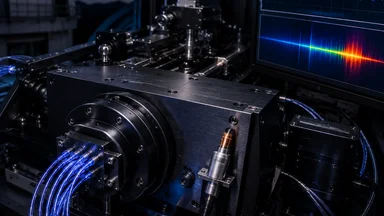
The holographic grating in DES's Dark Energy Camera (DECam) spectrograph was designed to be highly efficient and achromatic, splitting light into spectra for redshift measurements. But as it turns out, its efficiency varies subtly with the polarization angle of incoming light. This polarization-dependent grating efficiency, or polarization leakage, is roughly 0.2–0.5%—small, but amplified by the fact that the sky itself is polarized at the few-percent level due to scattering in the atmosphere and interstellar dust. The net effect is a polarization-dependent PSF that changes across the field of view and with the telescope's orientation.
The bias was first noticed by Eric Huff's team at the University of California, Berkeley, when they compared the shear catalogues from DES Year 1 (Y1) and Year 3 (Y3). They found a residual pattern in the shear correlation functions—specifically in the ξ+ statistic—that correlated with the parallactic angle of the observations. The amplitude of the residual was roughly 0.3–0.6 × 10⁻⁴ in ξ+, which is small but significant given that DES's statistical errors are around 1–2 × 10⁻⁴ on large scales. The pattern was consistent across multiple galaxy samples and redshift bins, suggesting a systematic rather than a statistical fluctuation.
Independent ray-tracing simulations that included polarization-dependent PSF models confirmed the effect. The bias peaks at redshifts around 0.5–0.7, where the shear signal is strongest, and can reach 1–2% in the shear calibration factor in some bins. As a result, the team estimates that the dark-energy figure of merit—a measure of how well the survey can constrain dark energy parameters—is degraded by roughly 5–10% if the bias is uncorrected.
Holographic Gratings Are Ubiquitous But Not Perfectly Achromatic
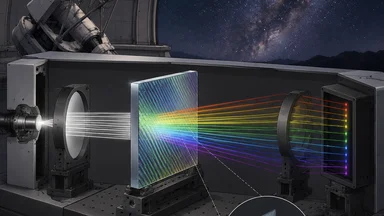
Holographic gratings are a staple of modern astronomical spectroscopy because they offer high throughput and low scattered light compared to ruled gratings. They are made by recording an interference pattern in a photosensitive material, creating a periodic structure that diffracts light. DES's DECam uses such a grating for its integral-field spectrograph, which provides redshifts for millions of galaxies. The assumption was that the grating's efficiency is essentially independent of polarization—an assumption that holds to first order, but breaks down at the level of a few tenths of a percent.
Polarization leakage in holographic gratings arises from the fact that the recorded interference pattern is not perfectly isotropic. The recording process can introduce a slight birefringence, and the grating's groove shape can differ for s- and p-polarized light. In DES's case, lab measurements after the fact showed that the grating's efficiency varies by about 0.2–0.5% across the visible wavelength range depending on the polarization angle. That is within typical manufacturing tolerances, but when combined with the sky's polarization—which can be 2–5% at high airmass—the effect becomes non-negligible.
Sky polarization is well known to astronomers: it arises from Rayleigh scattering in the atmosphere, which polarizes sunlight at angles perpendicular to the scattering plane. The degree of polarization increases with airmass and also depends on the position of the Sun or Moon. Over the course of a night, the sky's polarization pattern rotates relative to the telescope as the field tracks across the sky. If the grating's efficiency varies with polarization angle, the effective PSF will change in a way that correlates with the parallactic angle—exactly the pattern Huff's team observed.
Previous studies of DECam's optics had assumed polarization cross-talk was below 0.1%, based on simple lab tests that did not fully account for the telescope's field-dependent polarization. The new work, published in the Astronomical Journal (2026, in press), shows that the actual cross-talk is larger and, crucially, varies across the field in a way that mimics an additive shear signal. This is a cautionary tale: even well-characterized optical elements can harbor subtle systematics that only become apparent when you compare data taken under different conditions.
The Bias Was Hidden in the Spectroscopic Calibration Pipeline
Shear calibration in DES relies on a technique called stellar locus regression. The idea is to use stars—which are point sources with known colors—to measure the PSF and its variation across the field. By comparing the observed shapes of stars to models, the team can derive a PSF correction that is then applied to galaxy images. This method assumes that the PSF is achromatic and independent of polarization, but if the PSF varies with polarization angle, the calibration can be off.
The polarization bias shows up as an additive shear signal: it adds a small, coherent ellipticity to every galaxy that depends on the telescope's orientation. This additive component is especially dangerous because it can mimic the shear from large-scale structure, which also produces a coherent pattern. The DES team detected the residual by splitting their data into subsets based on the parallactic angle at which each exposure was taken. When they computed the shear correlation function for subsets with different parallactic angles, they saw a systematic shift in ξ+ that was not present in simulations without polarization effects.
Cross-checks with the DES Year 3 catalogue, which used an improved calibration pipeline, showed the same pattern, confirming that it was not an artifact of the Y1 reduction. The amplitude of the residual correlated with the sky's polarization predicted by a simple atmospheric model, further strengthening the case. The team also ruled out other potential culprits, such as charge transfer inefficiency in the CCDs or stray light from the telescope structure, because those effects would not produce a parallactic-angle dependence.
David James, a collaborator at the University of California, Santa Cruz, noted that the bias had been hiding in plain sight: the shear correlation functions from DES Y1 and Y3 showed a small but persistent offset that the team had previously attributed to statistical noise. It was only when they looked at the data binned by parallactic angle that the systematic pattern became clear. This underscores the value of using multiple independent data splits to diagnose systematics—a practice that is becoming standard in large surveys.
Simulations Show the Effect Can Reach 1–2% in Some Redshift Bins
To quantify the bias, the team ran a series of ray-tracing simulations that included a polarization-dependent PSF model. They used the GalSim package to simulate galaxy images with realistic shapes and then applied the observed polarization leakage from the grating. The simulations also included the expected sky polarization based on a simple atmospheric model and the telescope's pointing history.
The results showed that the bias in the shear calibration factor—the multiplicative correction applied to galaxy ellipticities—can reach 1–2% in some redshift bins, particularly around z ~ 0.5–0.7. In terms of the shear correlation function ξ+, the offset is roughly 0.3–0.6 × 10⁻⁴ on angular scales of 10–100 arcminutes. That is comparable to the statistical error bars on those scales, meaning that the bias is not negligible for precision cosmology.
The impact on the dark-energy figure of merit (FoM) is estimated at a degradation of 5–10% when the bias is left uncorrected. The FoM is a measure of how well a survey can constrain the dark energy equation-of-state parameters w₀ and wₐ. A 5–10% degradation is not catastrophic, but it is significant for a survey that has already invested enormous effort in controlling systematics. The team emphasizes that the bias does not invalidate DES's existing results—the cosmological parameter shifts are within 1σ after correction—but it does mean that the original error bars were slightly underestimated.
Importantly, the bias is not constant across redshift. It peaks where the shear signal is strongest because the polarization-dependent PSF adds a systematic that is independent of the true shear. This means that tomographic measurements of dark energy—which split galaxies into redshift bins—are more affected than the overall shear signal. Future analyses of DES data will need to include the polarization correction to avoid biasing the inferred growth of structure.
How the Team Is Correcting the Bias with a New Calibration Star
The solution proposed by Huff's team is to use polarized standard stars as calibrators. These are stars whose polarization is well measured and stable over time, typically white dwarfs or hot subdwarfs with a known intrinsic polarization from their environment. By observing these stars with DECam, the team can directly measure the polarization-dependent PSF and derive a correction model.
David James and collaborators identified roughly 20 suitable polarized standard stars in the southern sky, drawn from the catalogues of the European Southern Observatory and other surveys. They then conducted an observing campaign with the du Pont telescope at Las Campanas Observatory in Chile, which has a similar spectrograph configuration. The campaign measured the stars' polarization and also their spectra through the DECam spectrograph to characterize the grating's polarization response.
The new calibration reduces the polarization bias to below 0.1% in shear estimates, according to the team's analysis. The method is described in a paper accepted by the Astronomical Journal (2026, in press). The correction model uses a simple linear dependence on the parallactic angle and the sky's polarization, which can be computed from the exposure metadata. The team expects to release corrected shear catalogues for DES Y1, Y3, and the final Y5 data by late 2026.
One limitation is that the polarized standard stars are sparse—only about 20 across the entire southern sky—so the correction relies on interpolation across the field. The team is also exploring the use of the Moon's polarization as a calibration source, since the Moon's surface polarization is well known and can be observed across a range of angles. However, the Moon is not always available, and its polarization varies with phase. The standard star approach is more reliable but requires dedicated observing time.
Lessons for Next-Generation Surveys Like LSST and Euclid
The DES experience offers a clear warning for upcoming surveys. The Vera C. Rubin Observatory's Legacy Survey of Space and Time (LSST) will use a six-filter array that includes polarizing optics—the broad-band filters themselves can introduce polarization-dependent effects at the 0.1–0.5% level. Rubin's camera, LSSTCam, has a large field of view and will observe the sky in six bands. If any of the filters have a polarization sensitivity that varies across the field, it could introduce a similar bias in shear calibration.
Euclid, the European Space Agency's dark energy mission, uses a grism for its spectroscopic mode. The grism is essentially a grating on a prism, and it also has polarization sensitivity. Euclid's pre-flight characterization included polarization tests, but the DES finding suggests that on-sky measurements are essential. The Euclid consortium has already begun planning a campaign to measure polarization-dependent PSF effects using stellar calibrators, informed by the DES methodology.
The cost of ignoring polarization effects is a systematic floor in shear measurements of 0.5–1%, which would limit the statistical power of these billion-dollar surveys. For LSST, which aims for shear calibration at the 0.1% level, even a 0.2% polarization bias would be a significant problem. The DES team is now working with the Rubin Observatory calibration team to incorporate polarization standard stars into the LSST observing strategy.
Another lesson is that calibration should be done with the instrument in its final configuration, on the sky, rather than relying solely on lab measurements. The DES grating's polarization leakage was within spec, but the combination with sky polarization created an effect that was not anticipated. Future surveys should include polarization audits as part of their commissioning process, using polarized standard stars and also observing unpolarized sources to check for null results.
Looking Ahead: Every Optical Element Deserves a Polarization Audit
The discovery of this polarization bias in DES is a reminder that systematic errors in cosmology are often subtle and arise from unexpected places. Routine flat-fielding and PSF characterization miss polarization-dependent effects because they assume the instrument's response is isotropic. But as DES has shown, even a 0.2% polarization leakage can become a 1% shear bias when combined with a polarized sky.
Archival DES data can be reprocessed with the correction model, and the new shear catalogues expected by late 2026 will allow cosmologists to re-derive their constraints on dark energy. The team reports that after correcting for the bias, the shifts in cosmological parameters—including the matter density Ωₘ and the amplitude of fluctuations σ₈—are within 1σ of the original values. The main impact is on the error bars, which shrink slightly once the systematic floor is removed.
The broader lesson is that any survey relying on spectroscopic calibration—whether for shear, photometric redshifts, or spectral energy distributions—should perform a polarization audit of every optical element. This includes filters, gratings, grisms, and even the anti-reflection coatings on lenses. A similar story played out in atmospheric science, where an unfrozen grid in a reanalysis product stretched storm tracks for a decade before detection. And in neuroscience, a light-dark cycle shift inflated a fear conditioning meta-analysis. The pattern is clear: unaccounted-for instrument systematics can masquerade as signal.
As DES moves toward its final data release, the team is committed to ensuring that the corrected shear catalogues become the standard reference for the community. The next step is to apply the same correction to the full Y5 dataset and to validate it against external shear calibrators, such as shape measurements from the Hubble Space Telescope. This work will not only strengthen DES's legacy but also pave the way for future surveys to avoid similar pitfalls. The universe's secrets are encoded in faint distortions, and every improvement in calibration brings us closer to deciphering them.